Koa is a backend-only Node.js framework; SvelteKit is a full-stack frontend framework with its own server routes. See when they compete, when they pair, and starter kits using both.
Koa and SvelteKit overlap just enough to be confusing. Koa is a backend-only Node.js framework — a minimal async middleware pipeline for building APIs, with no opinion about your frontend. SvelteKit is a full-stack frontend framework: it renders Svelte components on the server, handles routing and data loading, and — crucially — includes its own server endpoints, which is where it starts to compete with Koa.
For many SaaS products, SvelteKit’s built-in server routes make a separate API framework unnecessary: form actions, load functions, and endpoints cover auth callbacks, CRUD, and Stripe webhooks inside one codebase. A standalone Koa API earns its place when the backend outgrows the frontend — multiple clients (mobile apps, third-party consumers) hitting the same API, long-running or queue-driven work, or a team split between frontend and backend ownership.
The practical rule: start with SvelteKit alone and add a dedicated Koa service only when you feel the pressure — premature separation costs you deployment and type-sharing complexity for nothing. The boilerplates on this page cover both shapes: SvelteKit full-stack starters, and stacks where a Koa API serves a SvelteKit frontend.
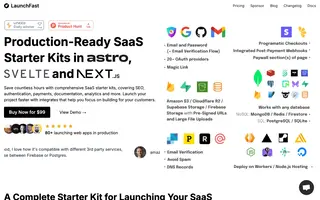
A production-ready SaaS starter kit available for Astro, Next.js, and SvelteKit, featuring comprehensive integrations and flexibility in database choice to help developers launch faster.
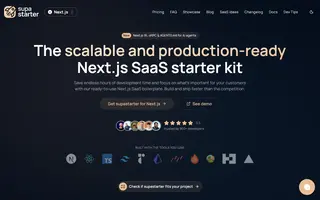
Created by experienced SaaS developers, this Next.js starter kit helps indie developers launch production-ready SaaS applications faster with integrated authentication, payments, and AI capabilities powered by Vercel's SDK.
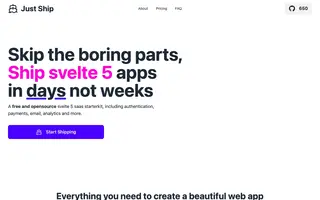
Created by Fulco, a fullstack developer, this Svelte 5 boilerplate helps developers ship SaaS applications faster with integrated authentication, payments, analytics, and landing page components powered by SvelteKit and Turso.
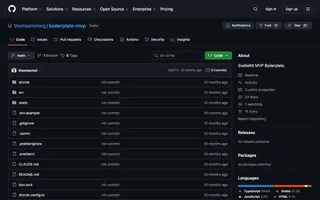
Created by Thomas Mol, a Dutch maker, this SvelteKit boilerplate helps developers launch SaaS and AI applications faster with integrated authentication, Stripe payments, and OpenAI API capabilities.

Created by indie hacker Rahul, this SvelteKit boilerplate helps developers launch SaaS products faster with integrated authentication, payment processing, and email capabilities powered by Supabase and Stripe.
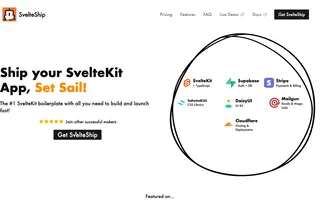
Created by Adel Ljaljic, this SvelteKit boilerplate helps developers launch full-stack SaaS applications faster with integrated authentication, Stripe payments, and Supabase backend functionality.
Explore other popular combinations with KOA or Svelte Kit
Vibe coding tools like Lovable and Bolt generate a working app from a prompt — but should you use one, or start from a boilerplate? An honest comparison by profile, product complexity, cost and code ownership.
Discover the key factors to consider when selecting a frontend language for your SaaS project. Compare TypeScript, JavaScript, Swift, and Dart to make an informed decision.
Compare modern frontend frameworks like Next.js, Nuxt, Vue, Angular, and Svelte. Learn about their strengths, use cases, and how to select the best one for your project.
Learn the essential steps to build a mobile SaaS application. Explore native vs cross-platform development, key technologies, and best practices for mobile-first SaaS solutions.
Explore comprehensive comparisons of backend languages and services, from Python and Node.js to Go and C#. Learn their strengths, limitations, and ideal use cases for your SaaS project.
They mostly solve different problems: SvelteKit is a full-stack frontend framework whose server routes handle typical SaaS backend needs; Koa is a dedicated backend framework. Start with SvelteKit alone, and introduce a separate Koa API when multiple clients, background jobs, or team structure demand an independent backend.