Koa is a minimalist Node.js framework for writing your own API; Supabase is a Postgres backend platform that generates one for you. Compare approaches and see starter kits using both.
Koa and Supabase both live on the backend, but they represent opposite philosophies. Koa is a minimalist Node.js framework from the team behind Express: it gives you an async/await middleware pipeline and almost nothing else, and you write every endpoint, auth flow, and database query yourself. Supabase is a backend platform: point it at your schema and it generates REST and realtime APIs over PostgreSQL, with authentication, row-level security, and storage built in — much of the code you would write in Koa simply doesn’t exist.
The trade-off is control versus speed. A Koa API is exactly what you make it: custom business logic, third-party integrations, background processing, any database. Supabase gets you to a working backend in hours, but complex server-side logic ends up in edge functions or an external service, and you are committed to Postgres and the Supabase way of doing auth. For a straightforward CRUD-heavy SaaS, Supabase alone is often enough; for products whose backend is the product, a framework like Koa keeps you unconstrained.
They also combine well: teams use Supabase for what it does best (managed Postgres, auth, realtime) and a small Koa service for the custom logic that doesn’t fit — webhook processing, billing orchestration, heavy integrations. The Koa service verifies Supabase JWTs, so there is one identity system across both. The boilerplates below take one of these approaches and ship it pre-wired.
The most popular AI app builder of the vibe coding wave: describe your SaaS in plain language and Lovable generates a React + Supabase application with auth, database and Stripe payments, hosted for you.
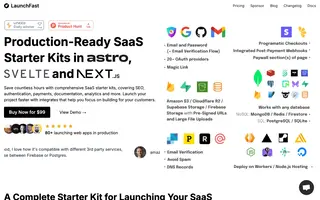
A production-ready SaaS starter kit available for Astro, Next.js, and SvelteKit, featuring comprehensive integrations and flexibility in database choice to help developers launch faster.
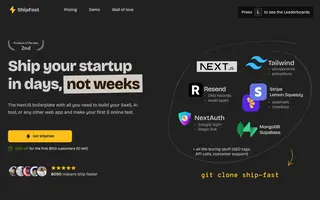
Made by Marc Lou, one of the most famous indie hackers, this boilerplate is simple, easy to use and fast to ship with.

Created by Matt Siatrak, a veteran Solution Architect, this SwiftUI boilerplate helps indie developers build, ship, and monetize iOS apps faster with integrated AI capabilities.
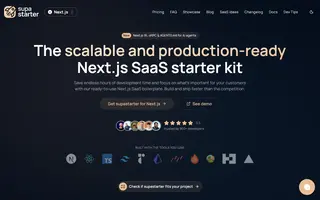
Created by experienced SaaS developers, this Next.js starter kit helps indie developers launch production-ready SaaS applications faster with integrated authentication, payments, and AI capabilities powered by Vercel's SDK.
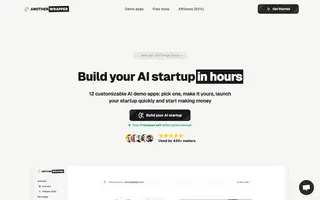
Created by an AI startup founder, this Next.js toolkit provides 10 ready-to-use AI demo apps and essential integrations to help developers launch AI-powered products in hours instead of months.

Created by Pauelle Limited, this React Native and Expo boilerplate helps mobile app developers launch products 80% faster with pre-built integrations for auth, payments, and notifications.
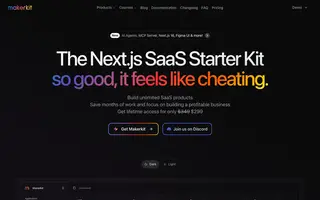
Created by Giancarlo Buomprisco, a 15-year software engineering veteran, this Next.js SaaS boilerplate helps developers launch production-ready applications faster with built-in authentication, multi-tenancy, and Stripe integration.
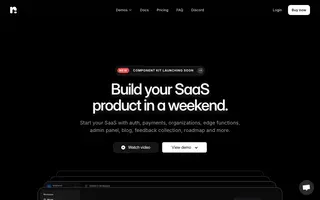
Created by Nextbase, this Next.js starter kit helps developers rapidly build production-ready SaaS applications with pre-built authentication, payments, and modern stack integrations including Prisma and Tailwind CSS.

Created by Melvynx, a prolific SaaS founder and course creator, this Next.js 15 boilerplate helps developers quickly launch production-ready applications with integrated authentication, Stripe payments, and organization management features.
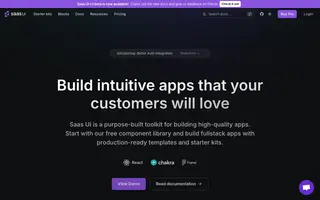
Created by Eelco Wiersma, this Chakra UI-based framework helps SaaS developers rapidly build professional web applications with 40+ production-ready components and pre-built authentication flows.
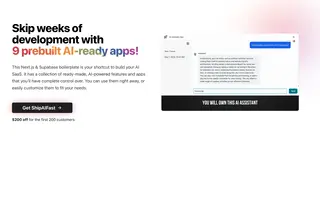
Created by a solo developer, this Next.js boilerplate helps entrepreneurs launch AI SaaS products faster with 9 pre-built AI apps integrated with OpenAI, Anthropic, and Replicate APIs.
Showing 12 of 24 boilerplates
Explore other popular combinations with KOA or Supabase
23boilerplates
21boilerplates
16boilerplates
3boilerplates
3boilerplates
2boilerplates
2boilerplates
2boilerplates
2boilerplates
Vibe coding tools like Lovable and Bolt generate a working app from a prompt — but should you use one, or start from a boilerplate? An honest comparison by profile, product complexity, cost and code ownership.
Discover the key factors to consider when selecting a frontend language for your SaaS project. Compare TypeScript, JavaScript, Swift, and Dart to make an informed decision.
Compare modern frontend frameworks like Next.js, Nuxt, Vue, Angular, and Svelte. Learn about their strengths, use cases, and how to select the best one for your project.
Learn the essential steps to build a mobile SaaS application. Explore native vs cross-platform development, key technologies, and best practices for mobile-first SaaS solutions.
Explore comprehensive comparisons of backend languages and services, from Python and Node.js to Go and C#. Learn their strengths, limitations, and ideal use cases for your SaaS project.
Choose Supabase when you want a working backend fast — managed Postgres, auth, and auto-generated APIs cover most CRUD-style SaaS needs. Choose Koa when your backend needs custom logic, integrations, or full control. Many teams use both: Supabase for data and auth, a small Koa service for the custom parts.